0-9
A
- Accuracy
- Overall correctness of a test (true positives and true negatives over all results).
General Terms
- Adenocarcinoma
- Adenocarcinoma is a type of cancer that starts in the gland cells of organs like the pancreas.
General Terms
- Artificial Intelligence (AI)
- Computer systems designed to perform tasks that normally require human thinking, such as recognizing patterns, learning from experience, and making decisions. In medical research, AI can help analyze large amounts of data to identify disease patterns or predict patient outcomes.
AI & Data Science
B
- Batch effect
- Unwanted differences in data that come from how or when samples were processed, rather than from actual biological differences. For example, samples processed on different days, with different equipment, or by different laboratory technicians may show variation that has nothing to do with the disease being studied. Researchers need to account for these effects to ensure accurate results.
Omics & Biomarkers
- Biobank
- A facility that collects, processes, stores, and manages biological samples (such as blood, tissue, or other bodily fluids) along with associated health information from donors. Biobanks are essential for medical research because they provide researchers with access to high-quality samples needed to study diseases like cancer, discover biomarkers, and develop new treatments. Participants typically provide informed consent for their samples to be used in research.
Clinical & Research
- Biomarker
- A biological molecule found in blood or other body fluids, or tissues that is a sign of a normal or abnormal process, or of a condition or disease like cancer.
General Terms
- Biomarker panel
- The combination of biomarkers (e.g. 10-biomarker panel).
General Terms
- Budget Impact
- The total financial impact of a new intervention on a healthcare payer’s budget over a specific time horizon, typically 1-5 years. This analysis considers all relevant costs, including the intervention itself, changes in resource use, and the number of people who would use the intervention. Budget impact analyses help healthcare decision-makers to understand whether they can afford to implement a new approach within their available budget, which is different from whether it provides a better value for money ratio (see cost-effectiveness)
Ethics, Policy & Health Economics
C
- CA 19-9
- Common serum biomarker for pancreatic cancer monitoring; it has a limited sensitivity and specificity for early detection.
Pancreatic Cancer Specific Terms
- Calibration
- A measure of how accurate a model’s predictions are in terms of probability. If a model says there’s a 70% chance of something happening, calibration checks whether that event actually occurs about 70% of the time. Good calibration means the model’s confidence levels match reality.
AI & Data Science
- Carcinoembryonic Antigen (CEA)
- It is a protein that is normally produced in very small amounts in healthy adults, but it can be found at higher levels in certain cancers such as pancreatic tumours and some non-cancerous conditions.
Pancreatic Cancer Specific Terms
- Cell-free DNA (cfDNA)
- Short DNA fragments found circulating freely in body fluids, primarily in blood plasma. These fragments are typically released through various mechanisms of cell death. In healthy individuals, the majority of cfDNA originates from hematopoietic (blood-forming) cells.
Liquid Biopsy + Components
- Chronic disease
- A chronic disease is a long-lasting health problem, like cancer. These conditions usually last many years and often require ongoing care and management.
General Terms
- Circulating tumour cells (CTCs)
- Circulating tumour cells are cancer cells that are travelling in the blood. Cells that travel through the blood can give rise to new tumours in other parts of the body (“metastasis”).
Liquid Biopsy + Components
- Circulating tumour DNA (ctDNA)
- A tumour-derived subset of cell-free DNA (cfDNA) found in the bloodstream. It consists of short DNA fragments released into circulation by cancer cells through apoptosis, necrosis, or active secretion. ctDNA carries tumour-specific genetic and epigenetic alterations, making it a powerful biomarker for non-invasive cancer detection, monitoring, and treatment guidance.
Liquid Biopsy + Components
- Clinical study
- A research investigation involving human participants designed to answer specific health-related questions. Clinical studies can be observational (researchers observe participants without intervening) or interventional (researchers test a treatment or intervention). These studies help advance medical knowledge, improve patient care, and develop new diagnostic or treatment approaches.
Clinical & Research
- Clinical trial
- A type of clinical study that is used to seek formal governmental approval (e.g., new medical devices, new drugs or the use existing drugs for a new disease) whether a new treatment, drug, medical device, or diagnostic test is safe and effective in humans. Clinical trials follow strict protocols, are governed by authorities and typically progress through phases (phase I to IV): early phases test safety in small cohorts, while later phases evaluate effectiveness in larger populations. Participants in clinical trials are closely monitored and provide informed consent.
Clinical & Research
- Clinical utility
- The practical value of a test or tool in helping doctors make better treatment decisions or improve patient outcomes in everyday medical practice. A test might be scientifically accurate, but it only has clinical utility if it actually helps guide treatment or changes patient care for the better.
Omics & Biomarkers
- Cohort
- A group of people who share a common characteristic or experience and are followed over time in a research study. For example, a pancreatic cancer cohort includes patients with pancreatic cancer. Researchers can study disease development, progression, and treatment outcomes in their cohorts.
Clinical & Research
- Cost-effectiveness
- A measure that compares the costs of a medical intervention to its health benefits. Cost-effectiveness analysis helps decision-makers determine whether new interventions should be adopted compared to an alternative. An intervention is considered cost-effective if its incremental health benefits justify its additional costs given a societal willingness-to-pay threshold when compared to existing alternatives.
Ethics, Policy & Health Economics
D
- Data fusion
- Combining information from different sources, such as blood tests, medical imaging, and genetic data, to create a more complete and accurate picture. By integrating multiple types of data, researchers can often make better predictions or gain insights that wouldn’t be possible from any single source alone.
AI & Data Science
- Data harmonization
- The process of making data from different sources compatible so they can be analyzed together. This involves standardizing things like measurement units, data formats, and terminology so that information collected at different hospitals or in different studies can be meaningfully compared.
AI & Data Science
- Data imputation
- A method for filling in missing information in a dataset using statistical techniques or patterns from the available data. Since medical datasets often have gaps (missed measurements, incomplete records), imputation allows researchers to use the full dataset for analysis rather than discarding incomplete records.
AI & Data Science
- Data privacy
- It is the principle that individuals should have control over how their personal information – such as medical or genetic data – is accessed and used. It ensures that data is protected, shared responsibly, and handled in ways that maintain trust and confidentiality.
Ethics, Policy & Health Economics
- Deep Learning
- An advanced type of artificial intelligence that uses layered networks (called neural networks) to find complex patterns in large amounts of data. The “deep” refers to the multiple layers of analysis, with each layer learning increasingly sophisticated features, similar to how the human brain processes information from simple to complex.
AI & Data Science
- Diabetes
- A chronic metabolic disorder characterised by elevated blood glucose levels (hyperglycemia) due to impaired insulin production, action, or both.
Pancreatic Cancer Specific Terms
- Diagnosis
- Diagnosis is the process of finding out what’s wrong when someone is sick. It involves tests and exams to identify the disease or condition causing symptoms.
General Terms
- Dimensionality reduction
- A method used to simplify large and complex datasets by reducing the number of measured features (also called “dimensions”), such as genes, proteins, or other variables. The goal is to keep the most important information while making the data easier to analyze, interpret, and use in models.
AI & Data Science
- Discrimination
- A model’s ability to correctly tell the difference between two groups our outcomes. For example, in cancer detection, this means how well the model can separate patients who have the disease from those who don’t. A model with good discrimination rarely mixes up the two groups, while a model with poor discrimination often confuses them.
AI & Data Science
- Downstream characterization
- The study of the biological changes that occur after an earlier event, such as a genetic change or a medical treatment. For example, if a gene changes first (“upstream event”), downstream characterization looks at what happens next — such as how proteins are produced, how cells behave, or how other processes in the body are affected by that upstream event.
Omics & Biomarkers
- Dysplasia
- Is a medical term that means “abnormal growth or development”.
Pancreatic Cancer Specific Terms
E
- Early detection
- Early detection means discovering a disease, like cancer, at an early stage before it causes serious problems. Detecting diseases early can make treatment more effective and improve chances of cure.
General Terms
- Economic impact
- The broader financial consequences of a disease, intervention, or healthcare program on individuals, healthcare systems, and society as a whole. This includes direct costs (such as hospital care and medications) and indirect costs (such as lost productivity due to morbidity or mortality). Understanding economic impact helps policymakers allocate resources and assess the full societal burden of diseases.
Ethics, Policy & Health Economics
- Epigenomics
- The study of chemical modifications to DNA and associated proteins that control whether genes are turned “on” or “off,” without changing the actual genetic code itself. These modifications can be influenced by factors like environment, lifestyle, and disease, and play an important role in cancer development.
Omics & Biomarkers
- Exosomes
- Tiny bubbles (vesicles) that cells release into their surroundings. They are like small packages that carry messages or materials from one cell to another. Exosomes are a subtype of EVs.
Liquid Biopsy + Components
- External validation
- Testing a model or biomarker using completely independent data that wasn’t involved in the development of the model or biomarker, typically data from different patients, hospitals, or time periods. This is the gold standard for proving that a test works reliably in the real world, not just in the original research setting.
Omics & Biomarkers
- Extracellular matrix (ECM)
- Is a network of molecules that surrounds and supports the cells in tissues and organs.
Pancreatic Cancer Specific Terms
- Extracellular vesicles (EVs)
- Small vesicles secreted by tumour cells; contain DNA, RNA, lipids, metabolites and proteins. Stable and rich in biomarkers.
Liquid Biopsy + Components
F
- False negative
- Test result indicating no disease when it is actually present.
General Terms
- False positive
- Test result indicating disease when it is not present.
General Terms
- Familial Pancreatic Cancer (FPC)
- Refers to cases of pancreatic cancer that occur within families at a higher-than-expected frequency, typically defined by the presence of two or more first-degree relatives (parent, sibling, child) diagnosed with pancreatic cancer, in the absence of a known hereditary syndrome.
Pancreatic Cancer Specific Terms
- Feature Selection
- The process of identifying which pieces of information (variables) in a dataset are most useful for making predictions. Rather than using all available data, which can include irrelevant or redundant information, feature selection focuses on the most informative factors to improve accuracy and make results easier to interpret.
AI & Data Science
G
- Genomics
- The comprehensive study of an organism’s complete set of DNA (the genome), including all genes and their functions. In cancer research, genomics helps identify genetic mutations and changes that drive tumor development or influence treatment response.
Omics & Biomarkers
H
- Health Care Impact
- The effect that a disease, treatment, or diagnostic approach has on the healthcare system, including factors such as resource utilization, demand for services, clinical workflows, and infrastructure requirements. Health care impact considers not just clinical outcomes but also how healthcare delivery itself is affected.
Ethics, Policy & Health Economics
- Health technology assessment (HTA)
- It is an evidence-based scientific process of assessing the added value of new health technology (e.g., medicinal products, medical devices, diagnostic tests) compared to current standards of care. HTA is able to contribute to the promotion of innovation, which offers the best outcomes for patients and society as a whole, and is an important tool for ensuring proper application and use of health technologies. The main aim of HTA is to provide policymakers with information so that they can formulate sound, evidence-based health policies.
Ethics, Policy & Health Economics
- Hereditary Pancreatic Cancer Syndromes
- A group of inherited genetic conditions that significantly increase an individual’s risk of developing PDAC. These syndromes involve germline mutations (an inherited mutation that is present in every cell of the body) in tumour suppressor or DNA repair genes (“brake” genes that usually stop cells from growing or dividing too much) and may occur with or without a strong family history.
Pancreatic Cancer Specific Terms
I
- Incidence
- Refers to the number of new cases (e.g. pancreatic cancer) diagnosed within a specific population over a defined time period, usually expressed as the number of cases per 100,000 individuals per year.
General Terms
- Individuals at risk
- Refers to people who have a higher likelihood of developing a specific disease – such as cancer – due to certain genetic, environmental, lifestyle, or medical factors. These individuals may not currently show symptoms but are more likely to benefit from targeted screening or preventive measures.
Pancreatic Cancer Specific Terms
- Inflammation
- Is the body’s biological response to harmful stimuli such as pathogens, damaged cells, or irritants. It is a key part of the immune system’s defence mechanism and can be acute (short-term) or chronic (long-term).
General Terms
- Informed consent
- The process by which a person voluntarily agrees to participate in research or receive a medical procedure after being fully informed about what’s involved. This includes understanding the purpose, procedures, potential risks and benefits, alternatives, and the right to withdraw at any time. Informed consent ensures that participants make educated decisions about their involvement and that their rights are protected.
Clinical & Research
- Internal test
- An evaluation of a model or test using data from the same group of patients or study that was used to develop it. While this provides initial evidence that the approach works, it doesn’t prove the test will work in different patients or settings, that requires external validation.
Omics & Biomarkers
- Intraductal papillary mucinous neoplasm (IPMN)
- A type of cystic tumour that arises from the pancreatic ducts, characterised by the production of mucin and a papillary (finger-like) growth pattern inside the ducts. IPMNs are considered precancerous lesions and can progress to invasive pancreatic cancer if left untreated.
Pancreatic Cancer Specific Terms
J
K
- KRAS mutation
- A genetic alteration in the KRAS gene, which encodes a protein involved in regulating cell growth, differentiation, and survival. KRAS is part of the RAS/MAPK signalling pathway in the cell, and mutations in this gene can lead to uncontrolled cell proliferation, making it one of the most common oncogenic drivers in human cancers.
Pancreatic Cancer Specific Terms
L
- Lesion
- A lesion is any abnormal change in the structure of an organ or tissue, typically caused by injury, disease, or infection. In the context of cancer, a lesion often refers to an area of abnormal tissue growth that may be benign (non-cancerous) or malignant (cancerous).
General Terms
- Liquid Biopsy
- A liquid biopsy is a simple fluid-based (e.g. blood) test that looks for signs of disease, especially cancer. Unlike traditional biopsies that require removing tissue from the body, liquid biopsy is quick, less invasive, and can help track how a disease is changing over time.
Liquid Biopsy + Components
- Longitudinal data
- Information collected from the same individuals repeatedly over an extended period of time. This type of data allows researchers to track changes, identify trends, and understand how diseases develop or progress. For example, in pancreatic cancer research, longitudinal data might include regular blood samples and health assessments from participants over several years.
Clinical & Research
M
- Machine Learning
- A type of artificial intelligence where computer algorithms learn to perform tasks by finding patterns in data, rather than following pre-programmed rules. The system improves its performance through experience, for example, learning to detect cancer by analyzing thousands of patient samples.
AI & Data Science
- Metabolites
- Metabolites are small molecules produced or used during metabolism within the human body. They play essential roles in energy production, signalling, and maintaining cellular function. They represent the metabolic phenotype, reflecting an organism’s physiological state.
Liquid Biopsy + Components
- Metabolomics
- The study of small molecules produced by cells (metabolites) during normal functions or in response to disease. These molecules, such as sugars, fats, and amino acids, can be measured in blood, urine, or tissue samples and provide a snapshot of what’s happening in the body at a molecular level.
Omics & Biomarkers
- Metastasis
- Metastasis occurs when cancer spreads from the original site to other parts of the body, forming new tumours (for example, when pancreatic tumour cells are in the brain or lung).
General Terms
- Microbiome metabolites
- Our body is populated by large consortia of microorganisms (the microbiome) that have a direct impact on human health. A dysbiosis, an alteration of their community composition, has been linked to disease development. Metabolites produced by the microbiome are key players in disease development and diagnosis.
Liquid Biopsy + Components
- MicroRNAs (miRNAs)
- Short non-coding RNAs circulating freely or within vesicles. They are dysregulated in many cancers and useful as diagnostic or prognostic markers.
Liquid Biopsy + Components
- Multi-omics integration
- Combining analyses from different biological layers, such as genes (genomics), proteins (proteomics), and metabolites (metabolomics), to gain a more complete understanding of how cancer develops and progresses. Each layer provides different information, and together they offer a more comprehensive picture than any single approach alone.
Omics & Biomarkers
- Multimodal Machine Learning
- An approach that combines and analyzes different types of data simultaneously, such as medical images, genetic information, blood test results, and patient records, to make more accurate predictions. By integrating multiple data sources, these models can capture complex relationships that single-source analyses might miss. It is a branch of machine learning.
AI & Data Science
N
- Negative Predictive Value (NPV)
- A statistical measure used in diagnostic testing that indicates the probability that a person with a negative test result truly does not have the disease. It measures how effectively a diagnostic test identifies true negatives.
General Terms
- Neuroendocrine tumour
- A rare type of neoplasm that arises from neuroendocrine cells—specialised cells that receive neural signals and release hormones into the blood. These tumours can be benign or malignant and are found most commonly in the gastrointestinal tract, pancreas, and lungs, but can occur anywhere in the body.
Pancreatic Cancer Specific Terms
- Non-invasive early cancer detection
- Refers to diagnostic methods that identify cancer at an early stage using minimally or non-invasive techniques, typically analysing molecular biomarkers in body fluids (e.g., blood, urine, saliva). These approaches aim to detect malignancy before symptoms appear, improving the likelihood of successful treatment and survival.
Liquid Biopsy + Components
- Non-omics biomarker
- A measurable indicator of disease or health status that doesn’t come from genetic, protein, or metabolite analysis. Examples include blood pressure, body temperature, tumor size on imaging, or levels of common blood substances. These traditional markers remain important alongside newer molecular biomarkers.
Omics & Biomarkers
- Normalization
- A statistical adjustment applied to data to account for technical differences that aren’t related to the biological question being studied. This ensures that observed differences between samples reflect actual biological variation (like disease status) rather than technical factors (like different amounts of starting material).
AI & Data Science
O
- Omics
- An umbrella term for fields that analyze biological systems on a large scale, including genomics (genes), proteomics (proteins), metabolomics (metabolites), and transcriptomics (gene activity). These approaches examine thousands of molecules simultaneously to understand complex biological processes in health and disease.
Omics & Biomarkers
- Outcome
- Refers to measurable results of a cancer diagnosis, treatment, or progression. They reflect the effectiveness, safety, and impact of medical interventions and are essential for evaluating patient prognosis, therapy success, and healthcare quality.
General Terms
- Overfitting
- When a machine learning model becomes too tailored to the specific data it was trained on, including random noise and peculiarities, making it perform poorly on new data. It’s like memorizing specific exam questions rather than understanding the underlying concepts – the model doesn’t generalize well to real-world situations.
AI & Data Science
P
- Pancreas anatomy
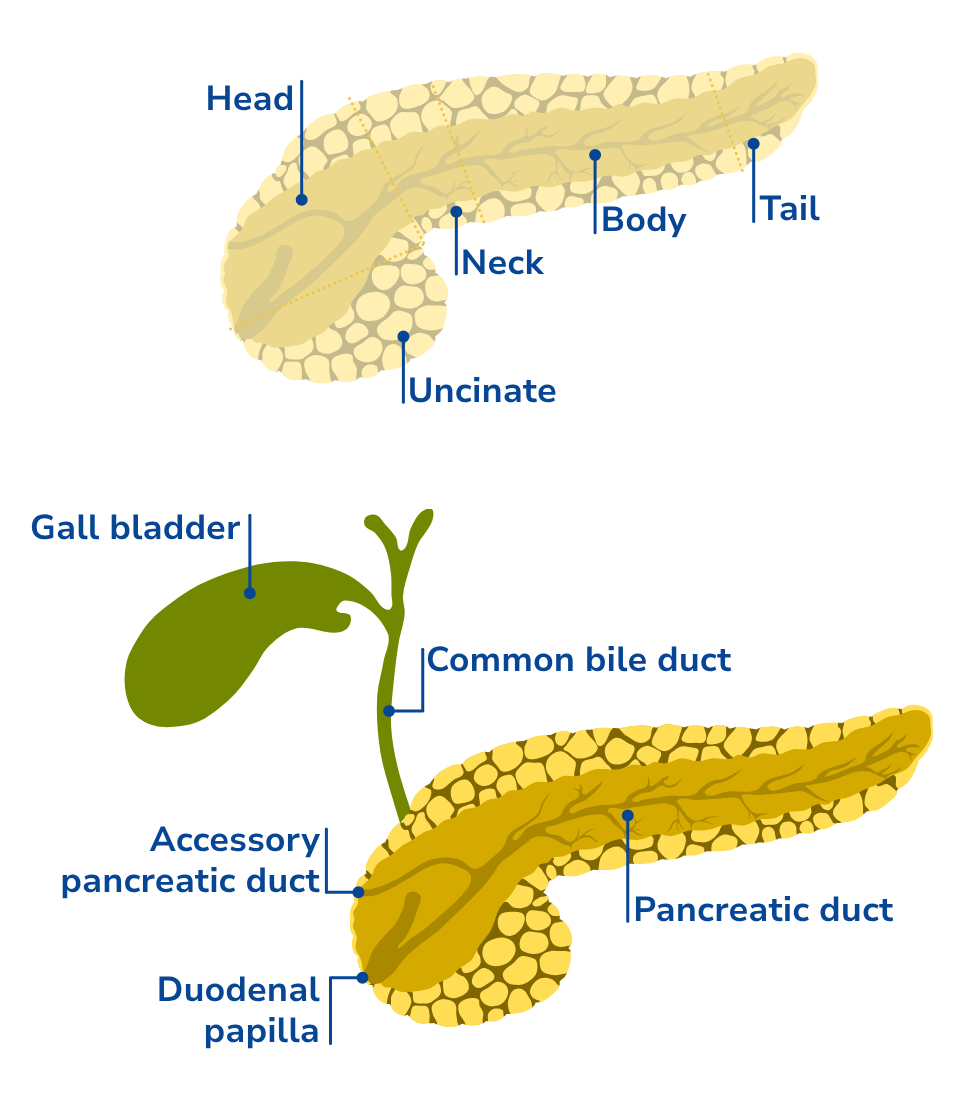
General Terms
- Pancreatic ductal adenocarcinoma (PDAC)
- The most common and aggressive form of pancreatic cancer, arising from the epithelial cells of the pancreatic ducts. It accounts for over 90% of all pancreatic malignancies and is typically diagnosed at an advanced stage due to its asymptomatic early course.
Pancreatic Cancer Specific Terms
- Pancreatic intraepithelial neoplasia (PanIN)
- Refers to a group of microscopic, non-invasive epithelial lesions in the small pancreatic ducts, considered to be precursor lesions to PDAC. These lesions represent a stepwise progression from low-grade dysplasia to high-grade dysplasia, eventually leading to invasive cancer.
Pancreatic Cancer Specific Terms
- Patient Advocacy
- It is the process of supporting and empowering patients to navigate the healthcare system and make informed decisions about their care. It involves acting on behalf of patients, or helping them to act for themselves, to ensure they receive the best possible care, access necessary resources, and have their voices heard. It can be done by professionals (like patient advocates or healthcare professionals), informal caregivers (like family members), or the patients themselves.
Ethics, Policy & Health Economics
- Patient Organisation
- As per the European Medicines Agency (EMA) definition, Patients’ organisations are not-for-profit organisations which are patient-focused, whereby patients and/or carers (the latter when patients are unable to represent themselves) represent a majority of members in governing bodies.
Key Features are:
Advocacy – they campaign for better access to healthcare, funding for research, and improved policies affecting patients;
Support – they provide emotional, informational, and practical support to patients, families, and caregivers;
Education – they help raise awareness and provide accurate information about a condition to patients, the public, and even healthcare professionals;
Research Involvement – many collaborate with researchers or pharmaceutical companies to help design clinical trials, gather patient perspectives, or fund research directly;
Representation – they act as the voice of patients in discussions with governments, regulators, and healthcare providers.
You can find a list of patient organisations in pancreatic cancer across Europe on 🔗 this webpage.
Ethics, Policy & Health Economics
- Plasma vs. serum samples
- Plasma and serum are both liquids taken from blood. Plasma contains soluble fractions such as proteins and clotting factors, while serum is plasma without those clotting factors. Both are used for testing, but they are prepared differently, and some tests work better with one or the other.
Liquid Biopsy + Components
- Positive Predictive Value (PPV)
- A statistical measure used in diagnostic testing that indicates the probability that a person with a positive test result actually has the disease. It reflects the test’s effectiveness in correctly identifying true positive cases.
General Terms
- Power calculation
- A statistical method used to determine the minimum sample size needed in a study to detect a true effect or difference with a specified level of confidence. In cancer research, it ensures that a study is adequately designed to evaluate diagnostic accuracy, treatment efficacy, or biomarker performance.
General Terms
- Pre-analytical variables
- Pre-analytical variables are all the factors involved before testing a sample, like how blood is collected, processed, stored, or transported. These factors can affect the accuracy of test results, so they must be carefully controlled to ensure reliable information.
Liquid Biopsy + Components
- Predictive modelling
- Using statistical methods or machine learning to forecast future outcomes based on patterns in existing data. In cancer research, this might mean predicting disease risk, treatment response, or patient survival based on clinical and molecular information.
AI & Data Science
- Prevalence
- Refers to the total number of existing cases of a specific disease or condition (such as cancer) within a defined population at a particular point in time or over a specific time period. Unlike incidence, which measures new cases, prevalence includes both new and pre-existing cases.
General Terms
- Prognosis
- Prognosis is a forecast about how a disease will progress. It includes predictions about recovery, possible complications, and how long someone might live with the condition.
General Terms
- Prospective study
- A research study that follows participants forward in time from the present into the future, collecting data as events occur. Unlike retrospective studies that look back at past data, prospective studies can be designed to gather specific, standardized information and establish clear timelines. This approach is particularly valuable for understanding disease development and has higher medical evidence than retrospective studies.
Clinical & Research
- Proteomics
- The large-scale study of proteins in cells, tissues, or bodily fluids, including which proteins are present, in what amounts, and how they function. Since proteins carry out most cellular functions, proteomics provides crucial information about what’s actually happening in cells, complementing genetic information.
Omics & Biomarkers
- Public health impact
- It refers to how a health issue, policy, intervention, or environmental factor affects the health of a group of people. It is typically measured by changes in rates of illness, death, or disability. This concept captures both how many people are affected and how serious the health consequences are. For example, a screening program that detects cancer early may reduce deaths and improve quality of life across a population, demonstrating a strong public health impact.
Ethics, Policy & Health Economics
Q
- Quality-adjusted life year (QALY)
- A measure that combines both the duration of a health state and its associated quality of life (anchored at 0 = “death” and 1 = “perfect health”) to evaluate health outcomes. One QALY represents one year of life in perfect health. The measure allows comparing health interventions across different disease areas. QALYs are a commonly used outcome measure in cost-effectiveness analyses.
Ethics, Policy & Health Economics
R
- Resectable vs. unresectable tumours
- A resectable tumour is one that can be completely removed by surgery with clear margins (no tumour cells at the edges of the resection). Surgical resection offers the best chance for curative treatment, particularly in cancers such as pancreatic cancer. An unresectable tumour is one that cannot be safely or completely removed by surgery, often due to extensive local invasion (e.g. into major arteries or organs), distant metastasis (e.g. liver, lung, peritoneum), poor patient health or surgical risk.
Pancreatic Cancer Specific Terms
- Retrospective study
- A research study that looks back at data or events that have already occurred, using existing medical records, stored samples, or historical information. Unlike prospective studies that follow participants forward in time, retrospective studies analyze past information to identify patterns, risk factors, or outcomes. While retrospective studies can be conducted more quickly and cost-effectively, they are limited to whatever data was previously collected and may be affected by incomplete records or inconsistent data collection methods.
Clinical & Research
- Right to know & Right to not know
- The right to know means that individuals have the right to receive clear, complete, and accurate personal health or genetic information—such as test results or risk levels—so they can make informed decisions about their health, treatment, or future planning. The right not to know allows individuals to decline or avoid personal health or genetic information if they choose. This respects their autonomy and can protect emotional well-being, especially when the information may be distressing or unwanted.
Ethics, Policy & Health Economics
- Risk factor
- A risk factor is something that increases the chance of developing a disease. Examples include smoking, family history, or other factors.
General Terms
- ROC Curve (Receiver Operating Characteristic Curve)
- A graphical plot that shows the diagnostic ability of a binary classifier system. It is a graph that shows how well a test or model can tell the difference between two groups, e.g. people with a disease and people without it.
General Terms
S
- Sample procurement method
- The specific procedures and techniques used to collect, handle, and prepare biological samples (such as blood, tissue, or urine) for research purposes. Standardized procurement methods are crucial because the quality and handling of samples can significantly affect research results (see batch effect). This includes factors like timing of collection, processing steps, and storage conditions. It is particularly important as further analysis may require a special sample collection method or pre-processing.
Clinical & Research
- Screening
- Screening involves tests done to find a disease early in healthy people before symptoms appear. It helps catch diseases like cancer early when they are easier to treat.
General Terms
- Sensitivity
- Sensitivity measures how good a test is at detecting a disease when it is actually there. High sensitivity means fewer missed cases, reducing false negatives.
General Terms
- Specificity
- Specificity measures how well a test correctly identifies people who do not have the disease. High specificity means fewer false positives and more accurate results.
General Terms
- Stakeholder engagement
- It is the process of involving individuals or groups who are affected by or can affect an organisation’s decisions or actions. It involves identifying, analysing, and prioritising stakeholders, then establishing communication and building relationships to achieve shared goals and manage potential conflicts. It means communicating and working with people who have a “stake” in what you’re doing, whether that’s a business project, a government policy, or a community initiative. It is crucial to build trust and transparency, to reduce resistance or conflict, to improve decision-making by incorporating diverse perspectives, and to increase support for the project or initiative.
Ethics, Policy & Health Economics
- Standard operating procedure (SOP)
- A detailed, written set of instructions that describes exactly how to perform a specific task or process to ensure it’s done consistently and correctly every time. In research and clinical settings, SOPs are essential for maintaining quality, ensuring reproducibility across different sites or time points, and meeting regulatory requirements. For example, an SOP might detail precisely how to collect and process blood samples for a study.
Clinical & Research
- Supervised Learning
- A machine learning approach where the algorithm learns from examples that are already labeled with the correct answer, such as samples marked as “cancer” or “no cancer.” The model uses these labeled examples to learn patterns that help it make predictions on new, unlabeled data.
AI & Data Science
T
- Training period
- The phase in developing a machine learning model where the algorithm is exposed to data and learns to recognize patterns and relationships. During training, the model adjusts itself to improve its predictions.
AI & Data Science
- Transcriptomics
- The analysis of all RNA molecules in a sample, which reveals which genes are actively being used (expressed) at a given time. Since cancer cells often have abnormal gene expression patterns, transcriptomics can help identify cancer-specific signatures and understand how tumors function.
Omics & Biomarkers
- Translational research
- Research that “translates” scientific discoveries from the laboratory into practical applications that improve patient care. This bridging work moves findings from basic science in the laboratory (“bench”) to clinical practice in the hospital (“bedside”) and back again, ensuring that laboratory discoveries lead to new diagnostic tools, treatments, or prevention strategies that actually benefit patients. Translational research is often described as moving along a continuum from discovery to real-world impact. In translational research scientists and clinician work together in a research team.
Clinical & Research
- True negative
- Test result indicating no disease when it is not present.
General Terms
- True positive
- Test result indicating disease when it is present.
General Terms
- Tumor vs host cells
- Tumor cells are cells that grow and divide uncontrollably, while host cells are the body’s healthy, normal-acting cells. These two cell populations don’t exist in isolation, but they constantly interact with each other. For example, pancreatic cancer cells communicate with surrounding immune cells and tissue, which can influence how the cancer behaves and responds to treatment.
Omics & Biomarkers
- Tumour microenvironment
- Refers to the complex and dynamic ecosystem surrounding a tumour, consisting of non-cancerous cells, signalling molecules, blood vessels, extracellular matrix (ECM), and immune components that interact with and influence tumor development, progression, and response to treatment.
Pancreatic Cancer Specific Terms
- Tumour Stage (TNM System)
- A globally recognised framework used to describe the extent and severity of cancer. Developed by the American Joint Committee on Cancer (AJCC) and the Union for International Cancer Control (UICC), TNM staging helps guide treatment decisions and estimate prognosis.
Pancreatic Cancer Specific Terms
U
- Unsupervised Learning
- A machine learning approach that finds hidden patterns or groupings in data without being told what to look for. Instead of learning from labeled examples, the algorithm identifies natural clusters or relationships in the data, which is useful for discovering previously unknown cancer subtypes or patient groups.
AI & Data Science
V
W
- Whipple Procedure (Pancreaticoduodenectomy)
- Surgical removal of the pancreatic head, duodenum, and other structures.
Pancreatic Cancer Specific Terms
X
Y
Z